System Monitoring vs. Reactive Repairs: How Oakdale Businesses Protect Refrigeration and HVAC Uptime
In Oakdale's Central Valley heat, the gap between a minor refrigeration fault and a full system failure can close in under four hours — especially overnight when no one is watching. A condenser fan motor losing efficiency at 2 a.m. raises discharge temps gradually, silently, and by the time staff arrive at 6 a.m., the product inside may already be unsalvageable. Continuous system monitoring exists specifically to catch that four-hour window before it costs you inventory, a health inspection, or an emergency dispatch at premium rates.
What Does Commercial Refrigeration Monitoring Actually Detect?
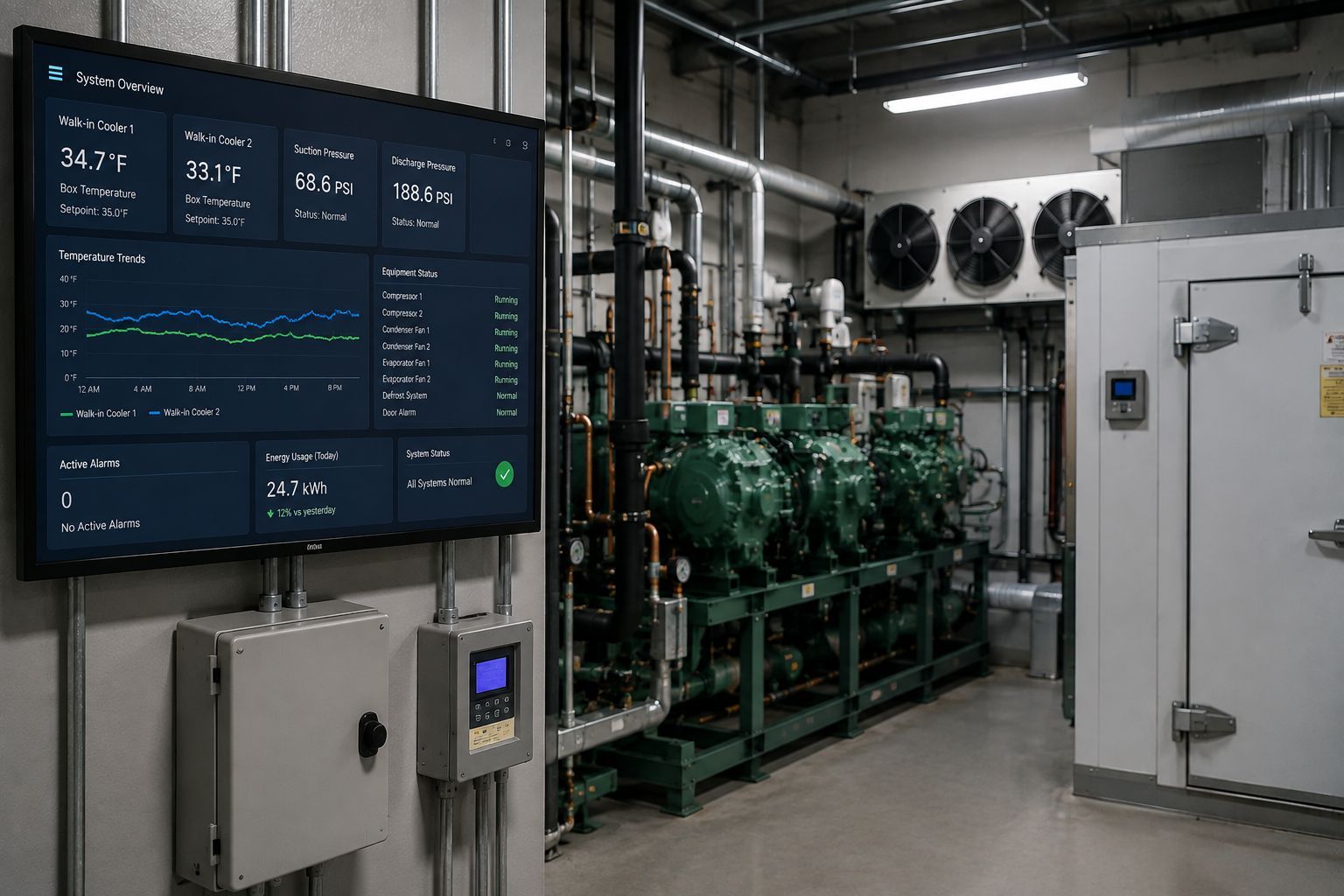
Monitoring sensors track specific equipment parameters in real time, generating alerts when readings drift past defined thresholds — not just when a unit stops working entirely.
On the refrigeration side, sensors watch suction and discharge pressure deviations, supply and return air temperature drift inside cases and walk-ins, compressor run-time patterns (short-cycling or extended runtime both signal developing faults), and electrical draw anomalies that indicate motor wear before the motor fails. Defrost cycle completion, door-seal open-door events, and ambient temperature correlation — how the 105°F July afternoon outside is loading your condenser — are all tracked parameters too.
For commercial HVAC systems, monitoring covers supply air temperature vs. setpoint, return air delta-T readings, refrigerant charge indicators, filter differential pressure showing airflow restriction, and compressor and fan motor electrical signatures. A compressor cycling pattern that shifts gradually over six weeks is invisible to a quarterly inspection but obvious in continuous trend data.
How Does the Alert-to-Response Workflow Actually Work?
An alert is only useful if a qualified person acts on it — here is what the sequence looks like from sensor trigger to corrective action.
First, the sensor crosses a defined threshold — say, box temperature rising 5°F above baseline for 15 continuous minutes. The monitoring platform logs the event with a timestamp and asset ID, then sends a notification to the on-call technician via SMS or app. The technician remotely reviews the data: is this a sensor glitch, a developing mechanical issue, or an active failure in progress?
From that remote assessment, three paths open. A remote adjustment may resolve the issue. A priority morning dispatch gets scheduled if the drift is slow and product is stable. Or, if the data shows active failure, 24/7 emergency service is triggered immediately. Every alert and response action is logged, and that data feeds directly into the next maintenance plan review.
Monitoring does not replace technician judgment — it ensures the technician is never the last person to know something is wrong.
How Does System Monitoring Integrate With a Maintenance Plan?
Scheduled maintenance visits cover what a technician can inspect on-site, but they leave 80 to 90 days of unobserved runtime between visits — and equipment degrades continuously, not on a quarterly schedule.
Trend data from monitoring tells the technician exactly what to prioritize when they arrive. Instead of a generic filter swap, they're addressing the compressor whose runtime crept up 12% over six weeks, or the evaporator coil showing early fouling in the performance data. A commercial maintenance plan paired with continuous monitoring closes that gap — scheduled visits handle physical inspection and component service, while monitoring catches the gradual degradation that visual inspection alone misses.
Used separately, each approach leaves a real exposure window. Used together, they form a full-coverage asset protection strategy where no failure mode goes undetected for long.
Is Monitoring the Right Call for Industrial Refrigeration Systems?
Monitoring is at least as justified for industrial refrigeration as it is for restaurant walk-ins — and often more so, because the stakes per failure event are proportionally larger.
Oakdale's dairy and food-processing operations run large compressor racks, handle significant refrigerant volumes, and store product at a scale where a single overnight temperature excursion translates to serious financial exposure. In multi-circuit industrial systems, monitoring can identify which specific circuit is degrading without requiring a full facility walkdown — a practical advantage when the system covers tens of thousands of square feet of cold storage.
The decision framework is straightforward: if your system runs overnight or on weekends without staff present, carries perishable or high-value product, or operates under health-code or food-safety regulatory requirements, break-fix is not an adequate risk management strategy. Industrial operators running primary refrigeration for production or distribution fall clearly into that category.
Central Valley Summer Heat and Your System's Risk Window
Oakdale's heat season runs from May through October, with ambient temperatures routinely exceeding 100°F in July and August — conditions that place sustained thermal stress on compressors, condensers, and refrigerant circuits every single day.
Under those ambient conditions, a condenser operating with even minor fouling or a fan motor running at reduced efficiency has dramatically less thermal headroom before discharge pressures spike into fault range. Power grid stress during peak heat events can compound the problem through voltage sags that alter compressor motor load. A fault that would be a manageable service call in a mild coastal climate becomes a same-night emergency in a Central Valley July. Monitoring's value scales directly with how hard your equipment is working — and in Oakdale's summers, it is working at its limits.
Continuous monitoring turns invisible overnight faults into actionable alerts before they become product loss, failed inspections, or emergency repair calls.
Schedule a monitoring assessment with Pro Edge Services and Training, Inc to define the right threshold parameters and response workflow for your specific refrigeration and HVAC assets.