Walk-In Cooler Drifting Warm? How to Trace the Cause
August 31, 2026
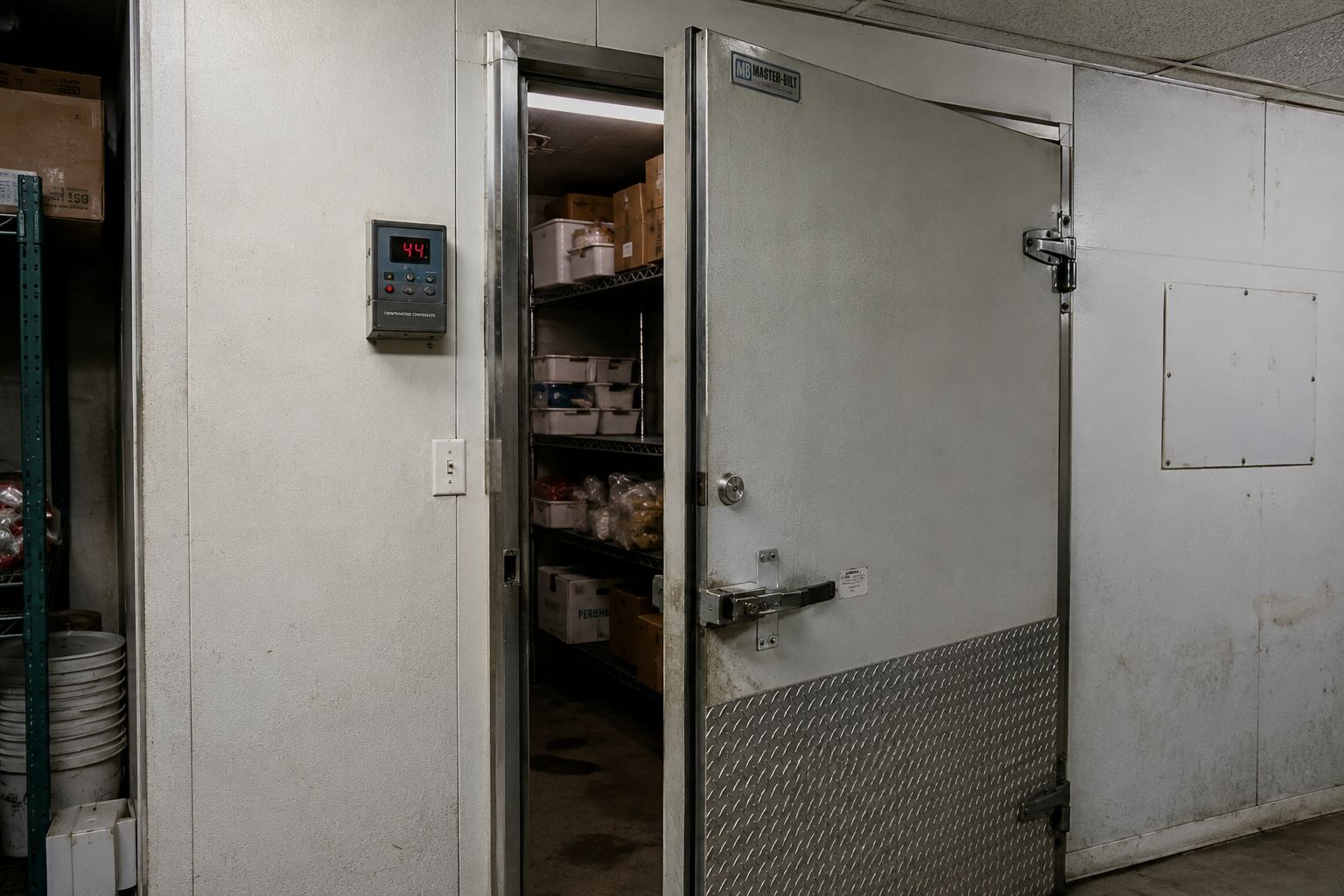
QUICK ANSWER: A walk-in that reads a few degrees warm is telling you a specific component has slipped, and the fault is almost always one of a short list: a worn door gasket, blocked airflow inside the box, dirty condenser coils, a defrost cycle that will not clear the evaporator, or a refrigerant charge that has quietly dropped. Tracing it means measuring before replacing anything: confirm the real box temperature, check the seal and the airflow, then read superheat, subcooling, and amperage before deciding whether the problem is mechanical or a lost charge.
One warm night in a walk-in can erase a week of margin. The box that held 36 degrees at close is reading 44 at open, the product inside is on the edge, and the morning that was supposed to be prep turns into damage control. The frustrating part is that the cooler rarely fails all at once. It drifts. A component gives up a little capacity, the compressor runs longer to cover for it, and the box holds temperature right up until a hot afternoon or a busy service tips it over.
In the Central Valley that tipping point arrives faster. When the outdoor air is above 100 degrees, the condenser is already working near the top of its range, so any hidden fault that was survivable in spring becomes a warm box in July. Tracing a walk-in cooler not holding temperature is a matter of ruling out causes in order, from the cheap and obvious to the ones that need gauges. Here is how that sequence runs.
Confirm the Drift Before You Chase It
Start by proving the box is actually warm, because the controller can lie. A display reading 36 while a calibrated thermometer inside the box shows 45 means the sensor or controller has drifted, not that the refrigeration failed. Set an independent, calibrated thermometer on a middle shelf, away from the door and the evaporator discharge, and compare it to the display. A gap of more than a couple of degrees points at the temperature control itself.
Mechanical thermostats drift out of calibration with age. Electronic controllers hold tighter but can fail at the sensor. Confirming the true temperature first keeps you from recharging a system that was never low, or replacing a compressor that was cooling fine while a dead sensor cycled it wrong.
The Door and the Seal
If the box is genuinely warm, the door is the first thing to check because it fails constantly and costs the least to fix. A gasket that has cracked, torn, or stiffened stops sealing, and every closed door then leaks cold air out and warm, humid air in. The compressor notices before you do: it runs longer and longer trying to cover the constant infiltration.
Warm humid air pulled in past a bad seal also feeds ice onto the evaporator, which is why a leaking door and a frosted coil often show up together. A door that no longer latches square, worn hinges that let the door hang open a crack, and grease built up on the gasket face all produce the same result.
TIP: Close the door on a dollar bill and pull. A sound gasket grips it with real resistance. If the bill slides out easily, the seal has failed at that spot, and you are cooling the room around the cooler every time the door shuts. Walk the whole perimeter this way, not just one corner.
Airflow Inside the Box
Cold air has to circulate across the product to hold an even temperature, and the fastest way to choke a walk-in is to overstock it. Cases stacked against the evaporator, boxes blocking the discharge, and shelves packed wall to wall all create warm pockets while the coil starves for return air.
This happens on delivery days. A big order lands, space is tight, and someone sets pallets right in front of the evaporator because there is nowhere else. A few hours later the box is warm and the compressor is running nonstop. Leave clearance around the evaporator so air moves freely, keep product off the coil, and pull shelving an inch or two off the walls.
The condenser needs breathing room too. If the condensing unit sits tight against a wall or its intake is blocked, it cannot dump heat, and the whole system loses capacity. Give it clear space on all sides.
Dirty Condenser Coils and Central Valley Heat
The condenser coil rejects the heat the system pulls out of the box. Coated in dust, grease, and airborne debris, it cannot release that heat, so head pressure climbs, the compressor runs hotter and longer, and the box still will not reach setpoint. Dirty coils are among the most common and most preventable reasons a cooler drifts warm.
This is where local conditions matter. Valley dust and long, hot summers load a condenser faster than a mild climate does. A coil that a general guide says to clean twice a year often needs it more frequently here, and a grease-heavy kitchen accelerates the fouling further. When head pressure is high on a hot afternoon and the coil looks matted, cleaning it is the first move before anyone reaches for gauges to check charge.
Defrost Faults and an Iced Evaporator
A walk-in has to defrost the evaporator on a schedule so frost does not build into ice and block the coil. When the defrost cycle fails, ice smothers the evaporator, airflow across it stops, and the box temperature rises even though the compressor is running.
The usual culprits are a failed defrost timer or controller, a burned-out defrost heater element, or a termination sensor that has drifted and ends the cycle too early. A clogged or frozen condensate drain line adds to the same picture, leaving water and ice where they do not belong. Tracing this means watching a full defrost cycle: confirm the heater energizes, the ice clears completely, and the termination point actually ends the cycle on a clean coil rather than leaving a rime that grows with every run.
When It Is Refrigerant or the Compressor
If the seal is good, airflow is clear, the coils are clean, and defrost is working, the fault moves into the sealed system. Low refrigerant shows itself as a box that never reaches setpoint no matter how long the compressor runs, frost forming in unusual spots, and sometimes a faint hiss near a fitting. Charge does not get consumed in normal operation, so a low system has a leak, and the leak has to be located before anything else.
Finding it is measurement work: an electronic leak detector, a nitrogen pressure test, or dye tracing to pin the exact joint. Once the failure point is repaired, the system is recharged to the manufacturer specification and verified with superheat and subcooling readings, not filled by feel.
The compressor is the last suspect and usually the victim rather than the cause. Grinding or clicking, frequent cycling, and a unit that has run nonstop for weeks all point to a compressor worn down by one of the faults above: dirty coils making it run hot, low charge making it run long, or poor airflow making it overheat. Finding the underlying fault is what keeps the most expensive part in the box from being the next thing to fail.
WARNING: Do not let anyone simply top off the refrigerant and leave. Adding charge to a leaking system buys a few days at most, then the box drifts warm again while the compressor keeps running against a low charge, and running long and hot against lost refrigerant is exactly what destroys a compressor. The leak gets found and repaired, or the failure repeats on a worse schedule.
Reading the System in Order
A walk-in that drifts warm is a diagnostic problem, not a parts-swap problem. Worked in order, the trace is quick: confirm the true temperature, check the gasket and the door, clear the airflow inside and around the box, clean and read the condenser, watch a defrost cycle, then put gauges on the sealed system and read superheat, subcooling, and amperage draw. Each step either finds the fault or rules a whole category out, so nothing gets replaced on a hunch. That measure-first order is what separates a repair that holds from one that has you back in the box next week.
Frequently Asked Questions
How long is the product safe once a walk-in stops cooling?
A closed, fully stocked walk-in cooler holds safe temperature for roughly four hours after a failure, less if doors keep opening. A packed freezer buys more time. Record the temperature immediately and keep doors shut.
Why does my compressor run constantly but the box is still warm?
Nonstop running almost always means lost cooling capacity, not a dead compressor. Low refrigerant, a dirty condenser, blocked airflow, or a failed door seal force the unit to chase an unreachable setpoint, not fail outright.
The controller reads the right temperature, so why is the box warm?
Because the controller only knows what its sensor tells it. A drifted or failed sensor can report 36 while the box sits at 45. Check real temperature with a calibrated thermometer on a middle shelf.
How often should the condenser coils be cleaned in a hot, dusty area?
More often than the twice-a-year figure suited to milder climates. Valley dust and long, hot summers load a condenser quickly, and a grease-heavy kitchen loads it faster still, so keep it clear through the summer.
Can a walk-in be diagnosed and repaired while it is still stocked?
Most walk-in repairs happen with product in place. Gasket work, coil cleaning, defrost repairs, and many sealed-system fixes are done around stocked shelves. Only a full offline repair or dangerous temperature calls for cold storage.
Is ice on the evaporator coil always a defrost problem?
Not always. Ice builds when too much moisture reaches a cold coil, so a failing door gasket that lets humid air in produces the same frosted coil as a broken heater. Ice is a symptom.
Reading the Warmth Before It Becomes a Loss
A walk-in cooler rarely fails all at once, and that is the useful part. Every drift toward warm carries a signal, from a gasket that no longer grips to a coil buried in dust to a defrost cycle that quietly stopped clearing ice. Ruling out causes in order, cheapest and most visible first, keeps a working compressor from being blamed for someone else's fault. The box is not being stubborn. It is reporting exactly where capacity slipped, and that report is worth reading closely before anything gets swapped out.
Pro Edge Services and Training, Inc
has spent 45
years in Oakdale, CA tracing these faults back to their source instead of guessing at parts. Superheat, subcooling, and amperage readings settle what a hunch cannot, and a leak gets found and repaired rather than papered over with a quick top-off. A cooler diagnosed in the right order tends to stay fixed, holding setpoint through the next hot stretch instead of drifting warm again on the next busy week.
System Monitoring vs. Reactive Repairs: How Oakdale Businesses Protect Refrigeration and HVAC Uptime